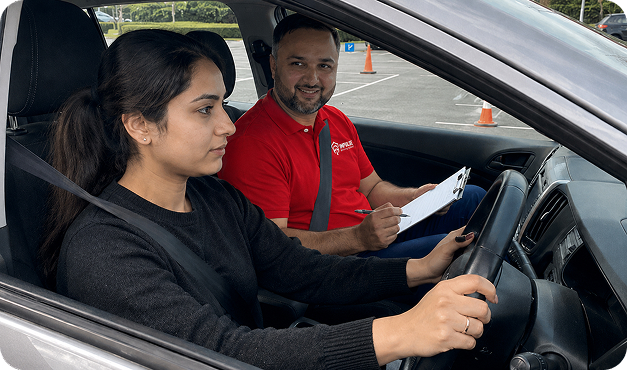



Pay as you go
£ 36.00/Hour
Book now

Taking a 1-week intensive driving course is a big leap. You’re learning fast, driving daily, and chasing one clear goal: passing your driving test. It’s totally normal to feel excited, nervous, and a little overwhelmed all at once.
Here’s the good news. Thousands of learners pass their driving test every year after an intensive course. The secret is smart preparation, knowing what examiners really look for, and keeping your cool on test day.
This guide explains exactly how to pass your driving test after a 1-week intensive course, with practical advice, realistic expectations, and proven strategies that work.

A week-long intensive driving course compresses months of learning into a short, highly focused period. Instead of spreading lessons over several weeks, you’ll be driving for multiple hours each day, allowing skills to develop quickly and consistently.
This repeated practice helps build strong muscle memory and sharper road awareness in a short time.
During the week, you’ll cover everything from basic car control to complex junctions, driving test manoeuvres, and real test routes like navigating Cheetham Hill Road and Princess Parkway in Manchester, which often feature on practical test routes used by DVSA examiners in the area.
Lessons are structured to identify weaknesses early and fix them fast, which is why progress often feels rapid.
These courses work best when:
It’s important to understand that intensive courses are not shortcuts. You still need strong observation skills, confident decision-making, and full control of the car in real traffic situations.
The course simply accelerates learning by removing long gaps between lessons and keeping everything fresh in your mind.
When approached with the right mindset, a 1-week intensive course can be an effective way to prepare for your driving test and build genuine confidence behind the wheel.
Many learners ask how long it takes to pass your driving test after completing a 1-week intensive course. The honest answer is that it varies from person to person and depends on how quickly you adapt to learning in a short, focused timeframe.
Your progress is influenced by your starting skill level, how well you absorb instructor feedback, and how effectively you manage driving test nerves.
Some learners are test-ready within a week, while others benefit from a few additional lessons to polish specific skills. An intensive course accelerates learning, but passing your test is about readiness, not speed.
Factor
1-Week Intensive Course
Traditional Driving Lessons
Lesson Frequency
Daily, multiple hours
1–2 lessons per week
Learning Speed
Fast, highly focused
Gradual, spaced learning
Skill Retention
Strong due to repetition
Can weaken between lessons
Test Readiness
Often within 1–2 weeks
Usually several months
Best For
Learners who can fully commit
Learners who prefer flexibility
Handling Test Nerves
Improves quickly with exposure
Builds confidence slowly
This comparison helps learners understand why intensive courses can be effective, while also setting realistic expectations about passing timelines.
Our advice would be to primarily focus on consistency rather than perfection. Examiners are not expecting faultless driving. What they really want to see is that you can drive safely and independently.
During a 1-week intensive course, progress happens quickly, but only if you stay focused and receptive. Learners who pass the first time usually demonstrate that they are:
Listening carefully to your instructor, applying feedback immediately, and practising with purpose are what truly make the difference.
Small improvements made consistently throughout the week often lead to a confident, first-time pass.
Completing a mock driving test during the week is also an effective way to prepare. It highlights habits you may not notice in normal lessons, helps reduce driving test nerves, and makes the real test feel familiar rather than intimidating.
Understanding driving test rules is essential, especially during a 1-week intensive course where you’re absorbing a lot of information in a short time. Many learners fail not because they can’t drive, but because small rule-related mistakes turn into serious faults.
One of the most common reasons learners fail is letting their speed slowly creep above the limit. This often happens on wide roads, downhill sections, or when trying to keep up with traffic. Examiners expect you to actively control your speed at all times. Even briefly exceeding the limit can result in a serious fault if it shows a lack of awareness.
Late signalling, signalling after starting a manoeuvre, or forgetting to cancel indicators can confuse other road users. Examiners want to see signals given early, clearly, and at the correct time. Poor signalling suggests weak planning and can quickly add unnecessary faults.
Lane discipline regularly catches learners out, especially at roundabouts and multi-lane junctions. Choosing the wrong lane, drifting between lanes, or cutting across road markings shows uncertainty. Examiners expect you to read signs early, choose the correct lane in advance, and maintain it confidently.
Incomplete mirror checks are one of the easiest ways to lose marks. Learners often check mirrors when pulling away but forget to do so when changing speed, direction, or position. Examiners look for clear, visible mirror checks, especially before signalling, slowing down, or manoeuvring.
Driving test nerves are completely normal. Even confident learners feel anxious on test day.
The key isn’t removing nerves, but staying in control of them.
Take slow breaths before starting, focus on the next action, and don’t dwell on small mistakes. One error doesn’t mean failure unless it becomes unsafe. Stay present and keep driving calmly.
If confidence is something you’re still building, we also have a dedicated blog on how to gain confidence while driving, packed with practical tips to help you feel more relaxed and in control behind the wheel.
Ask any instructor, and they’ll tell you this: most learners don’t fail because they can’t drive; they fail because nerves take the wheel. Panic causes rushed decisions, not a lack of skill.
Trust the training you’ve already put in, take your time, and aim for safe driving, not superhero driving. Examiners aren’t hunting for perfection. They want calm, controlled decisions.
Treat the test like just another lesson, let muscle memory do its thing, and drive the way you already know how to.
Our advice comes directly from experienced UK driving instructors who prepare learners for practical tests every week, including intensive and first-time candidates.
At the end of your practical driving test, the examiner will tell you the result straight away at the test centre. You won’t need to wait days or check online later; you’ll know immediately if you passed or not.
If you pass, the examiner may also show you a pass certificate or explain any minor faults recorded.
If you don’t pass, they will give detailed feedback on areas that need improvement, which is invaluable for your next attempt and can help you tailor future practice to avoid the same mistakes.
How to pass your driving test in under a week-long intensive course is absolutely achievable with the right mindset, preparation, and support. It’s not about rushing or being perfect. It’s about driving safely, staying calm under pressure, and trusting the skills you’ve built through focused training.
At Impulse Drive, we work with learners every week, preparing for practical driving tests across the UK. Our instructors have guided nervous beginners, intensive course learners, and first-time test candidates through real test routes and real examiner expectations.
The advice in this guide is based on what we see learners struggle with most and what actually helps them pass
Some learners pass within a week, while others need a few extra lessons. It depends on your starting level, confidence, and how well you handle feedback and test nerves.
Yes. Many learners do, especially if they already have basic road awareness and fully commit to daily practice and instructor feedback.
They can be. Intensive courses help build confidence quickly, but nervous drivers benefit most when lessons include calm instruction, mock tests, and confidence-building support.
The most common reasons are nerves, rushed decisions, missed mirror checks, poor lane discipline, and hesitation at junctions, rather than a lack of driving ability.
Arrive early, breathe slowly, reset after small mistakes, and focus only on the next action. Treat the test like a normal lesson, not a final judgement.