

Pay as you go
£ 36.00/Hour
Book now

Many learners lose marks on the Hazard Perception Test even when they spot the hazard correctly. The problem is timing. Click too early, and the system may not count it. Click too late and you lose points.
This guide explains exactly when to click, how scoring works, how many times you can click safely, and how to practise before your UK theory test.
To pass the Hazard Perception Test, click when a potential hazard starts developing into something that could make you slow down, stop, or change direction. Do not click as soon as something appears on screen, and do not wait until the danger has already happened.
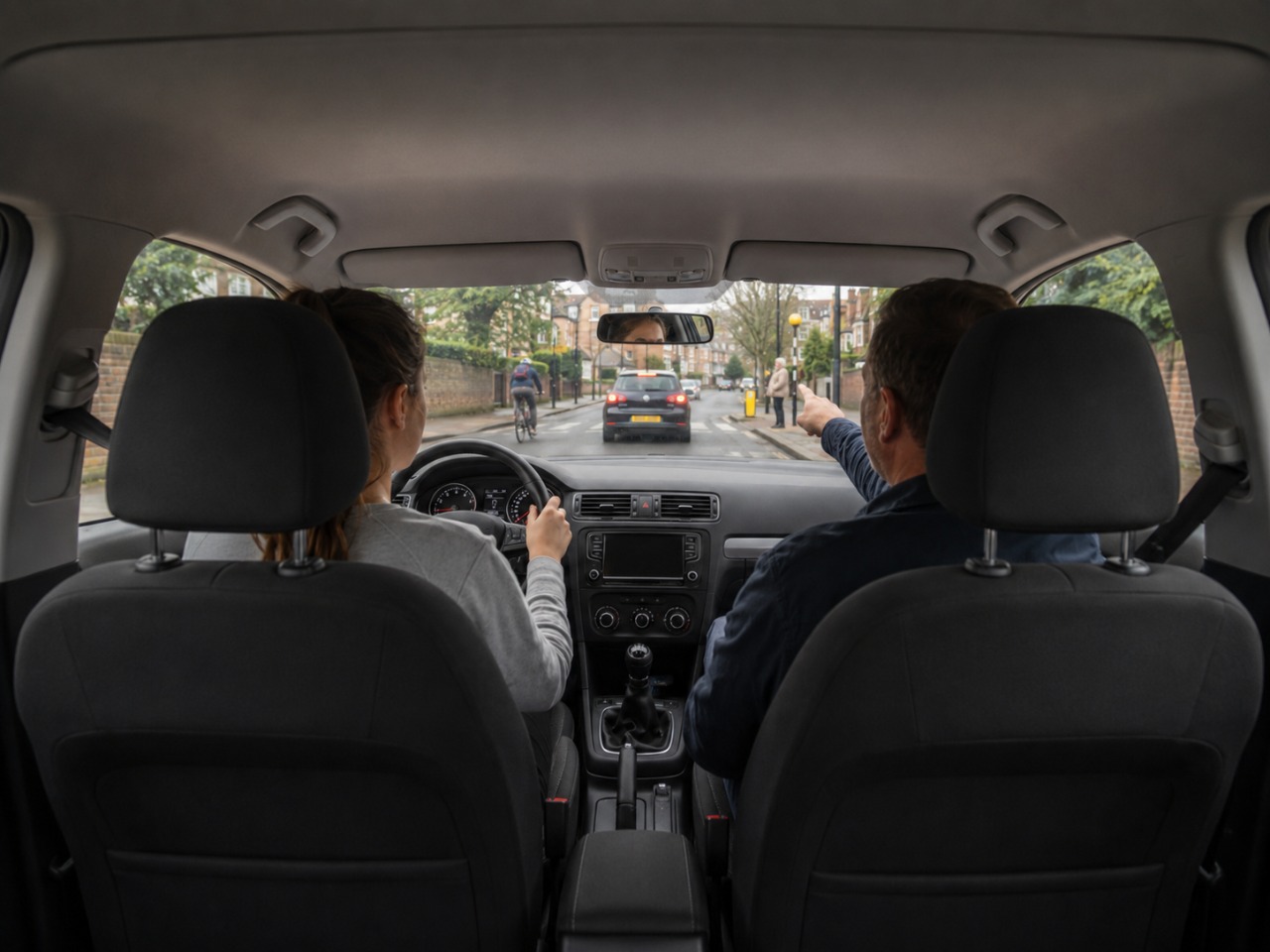
The hazard perception test is computer-based and forms part of the DVSA driving theory exam. You watch video clips of real driving scenarios and click when you spot a hazard that develops, not just anything moving on screen.
Quick facts:
These figures are based on the official DVSA theory test format for car drivers, where the hazard perception section includes 14 video clips, 15 developing hazards, and a pass mark of 44 out of 75.
Passing this section isn’t just for the exam; it teaches real-world driving skills:
Click when the hazard starts to develop, not when it first appears on screen and not when the danger has already happened.
A good rule is to ask: “Would this now make me slow down, change direction, or stop?” If the answer is yes, that is usually the right moment to click.
For example, a pedestrian standing near the kerb is only a potential hazard. If they turn their body toward the road, look ready to cross, or begin stepping forward, the hazard is developing. That is when you should click.
Use this simple timing guide:
Timing
What It Looks Like
Score Impact
Too early
The person is only walking on the pavement
May score 0 because the hazard has not developed yet
Right time
The person turns toward the road or steps toward the kerb
Best chance of scoring 4 or 5 points
Too late
The person is already crossing in front of you
Usually scores fewer points or 0
The test rewards anticipation. You do not need to wait until the hazard becomes dangerous. You need to click when it starts becoming relevant to your driving.
Think of the Hazard Perception Test as a preview of situations you'll face once you're driving alone. The clips are designed to test whether you can spot trouble before it forces you to react.
Each clip contains developing hazards that require your attention, not just things moving randomly. Understanding how the test works and practising anticipation are key to scoring high.
Many learners lose points because they misunderstand what the test is actually measuring. The goal is not to click when something is already dangerous. The goal is to click when a potential hazard starts developing into something that could affect your driving.
For example, a pedestrian walking on the pavement is only a potential hazard. When they turn toward the road and may step into your path, the hazard starts developing. That is the point where you should click.
Each developing hazard is worth up to 5 points. The earlier you identify it within the scoring window, the more points you receive.
How scoring works:
The pass mark for the hazard perception section is 44 out of 75. That is why timing matters so much. You do not need to click perfectly every time, but you do need to understand when a hazard starts to develop.
For a deeper breakdown of scoring windows and points, read our DVSA Hazard Perception Scoring guide.
One of the biggest reasons learners lose points is that they confuse potential hazards with developing hazards.
A potential hazard is something that could become dangerous.
A developing hazard is something that is starting to affect your driving and may require you to slow down, change direction, or stop
Situation
Potential Hazard
Developing Hazard
Pedestrian on pavement
Walking normally
Steps toward the road
Parked vehicle
Stationary at the roadside
Starts pulling out
Cyclist ahead
Riding predictably
Begins moving into your lane
Vehicle at the junction
Waiting to emerge
Starts edging into traffic
The key is to click when the situation begins to develop, not when it first appears and not when the danger has already happened.
Imagine you’re driving along a residential road and see a pedestrian walking on the pavement. At first, they are only a potential hazard.
When they turn toward the kerb and look ready to cross, the hazard starts developing.
That is when you should click. The test rewards early anticipation, not late reaction.
There is no official limit on the number of times you can click during a clip.
However, repeatedly clicking throughout a clip in a pattern can trigger the DVSA's anti-cheating system and result in a score of zero for that hazard.
Many successful learners use a controlled approach rather than relying on a single click.
A common technique is:
This approach can improve your chances of scoring points without triggering excessive-click penalties.
You will not lose points for one wrong click, but repeated clicking can be treated as suspicious. The system may give you zero for that clip if you click continuously or use a clear pattern.
A safe method is to use purposeful clicks only when the hazard develops. Do not click every few seconds. Do not click randomly across the clip. Every click should be linked to something changing on the road.
The three-click method is a popular technique used by many driving instructors to help learners improve their Hazard Perception Test scores.
Instead of relying on one perfectly timed click, learners make up to three measured clicks as the hazard develops.
How it works:
For example, if a car begins edging out of a side road:
The key is to keep the clicks natural and related to the developing hazard. Random or excessive clicking can result in penalties, so use the method carefully and only when a genuine hazard is developing.
The multiple-choice section gives you 57 minutes to answer 50 questions. After that, you may have a break of up to 3 minutes before the Hazard Perception Test starts.
This helps learners pace themselves and manage stress during the exam.
The Hazard Perception Test usually takes around 20 minutes. You watch 14 video clips and respond when you see developing hazards. The full car theory test takes longer because it also includes the multiple-choice section, where you have 57 minutes to answer 50 questions.
Mark was one of our learner drivers at Impulse Drive who understood the rules but struggled with click timing during hazard perception practise.
Mark’s biggest issue was clicking after the hazard had already become obvious.
During lessons, his instructor asked him to focus on the first sign of change, such as a car edging forward, a cyclist drifting out, or a pedestrian turning toward the kerb.
After practising with DVSA-style clips and real Manchester traffic examples, his timing became more consistent.
By understanding how the hazard perception test works and applying these strategies, learners can move from guessing and reacting to predicting and scoring consistently.
Problem
What It Usually Means
How to Fix It
You keep scoring 0
You may be clicking too early, too late, or in a pattern
Click only when the hazard starts to develop
You score 1 or 2 often
You are spotting the hazard too late
Look further ahead and scan pavements, junctions and parked cars
You click too much
You are reacting nervously instead of judging the scene
Use controlled clicks only when something changes
You miss side hazards
You are watching only the car ahead
Scan the full screen, including kerbs, side roads and mirrors
You panic during clips
You are treating it like a reaction test
Treat each clip like real driving and predict what could happen next
Even confident learners can lose marks during the Hazard Perception Test if they misunderstand timing, focus, or scoring. Here are the most common mistakes to avoid:
Many learners click as soon as something moves on screen. The problem is that not every movement is a developing hazard. You need to click when the hazard starts to affect your driving, not before or after the danger has already happened.
A car parked near a junction is only a potential hazard. It becomes a developing hazard when it starts moving into the road. Recognising this difference is key to scoring consistently.
Focusing only on the vehicle ahead can make you miss pedestrians, cyclists, parked cars, or traffic emerging from side roads. Train yourself to scan the full scene, including pavements, junctions, mirrors, and road edges.
The timed nature of the test can make learners click impulsively. Stay calm, watch the full scene, and treat each clip like a real driving situation. Better observation leads to better timing.
Most Hazard Perception Test mistakes come from poor timing, narrow focus, or panic clicking. With structured practice and a clear understanding of developing hazards, the test becomes much easier to manage.
Revision is key to passing both parts of the DVSA theory exam, and a smart approach saves time and builds confidence. Here’s how learners can tackle both effectively:
DVSA car theory test data shows pass rates are tracked nationally and by test centre, which is why learners should prepare seriously for both the multiple-choice and hazard perception sections.
The theory test includes 50 questions covering road rules, signs, and driving scenarios. Use official DVSA question banks or reputable online mock tests to familiarise yourself with the style, phrasing, and common traps. Focus on understanding the “why” behind each answer, not just memorising facts.
Hazard perception requires spotting developing hazards in video clips. Watch official DVSA practice clips regularly, ideally under timed conditions, to simulate the real test. Train your eyes to scan the whole screen, anticipate danger, and click at the right moment, not too early or too late.
Don’t treat multiple-choice questions and hazard perception as separate worlds. Practising both in one session helps train your brain to switch between knowledge recall and hazard anticipation, reflecting the actual test experience.
Simulate real exam conditions by timing yourself on full-length mock tests. This helps with pacing, reduces test-day nerves, and lets you apply hazard spotting in the same timeframe as the official exam.
Take short drives (as a passenger if you’re not yet on the road) to spot hazards like cyclists, pedestrians, or parked cars. Relating real traffic scenarios to practice clips reinforces anticipation skills.
With this approach, learners can build confidence, reduce anxiety, and improve scores in both the theory and hazard perception parts of the DVSA exam.
Practice consistently, focus on understanding hazards, and use mock tests to track progress.
Day 1: Learn the difference between potential and developing hazards. Day 2: Watch 10 practice clips and pause after each one to identify the developing hazard. Day 3: Practise click timing without worrying about score. Day 4: Take a full hazard perception mock test. Day 5: Review every low-score clip and write down why you clicked too early or too late. Day 6: Practise mixed clips with pedestrians, cyclists, junctions and parked vehicles. Day 7: Take one final mock test under exam conditions.
The Hazard Perception Test and the full DVSA theory test are essential stepping stones for every learner driver, building skills that extend beyond the exam. Mark found success by combining structured practice, real-world scenarios, and expert guidance from Impulse Drive instructors, turning initial nerves into confidence.
Preparing thoughtfully, practising hazard anticipation, and understanding test timing are key to passing both sections.
Ready for your theory test? Our instructors help learners prepare for both the multiple-choice and hazard perception sections with practical guidance, mock tests, and real-world hazard awareness training.
Book your driving lessons with Impulse Drive today.
There is no fixed official limit, but repeated pattern clicking can trigger the anti-cheating system. A controlled three-click method is safer than clicking continuously throughout the clip.
The multiple-choice section gives you 57 minutes to answer 50 questions. After that, you may have a break of up to 3 minutes before the Hazard Perception Test starts.
The Hazard Perception Test usually takes around 20 minutes. You watch 14 clips and respond when developing hazards appear.
There are 50 multiple-choice questions and 14 scored hazard perception clips. The hazard perception section has 15 developing hazards in total because one clip includes two hazards.
Use official DVSA practice clips for hazards, review multiple-choice questions, take mock tests under timed conditions, and practice spotting hazards in real traffic scenarios.
You can book a theory test UK directly on the official DVSA website. Booking early gives you time to revise and practise hazard perception clips before your exam.